* * * * * English version after this post * * * * *
Buenos días,
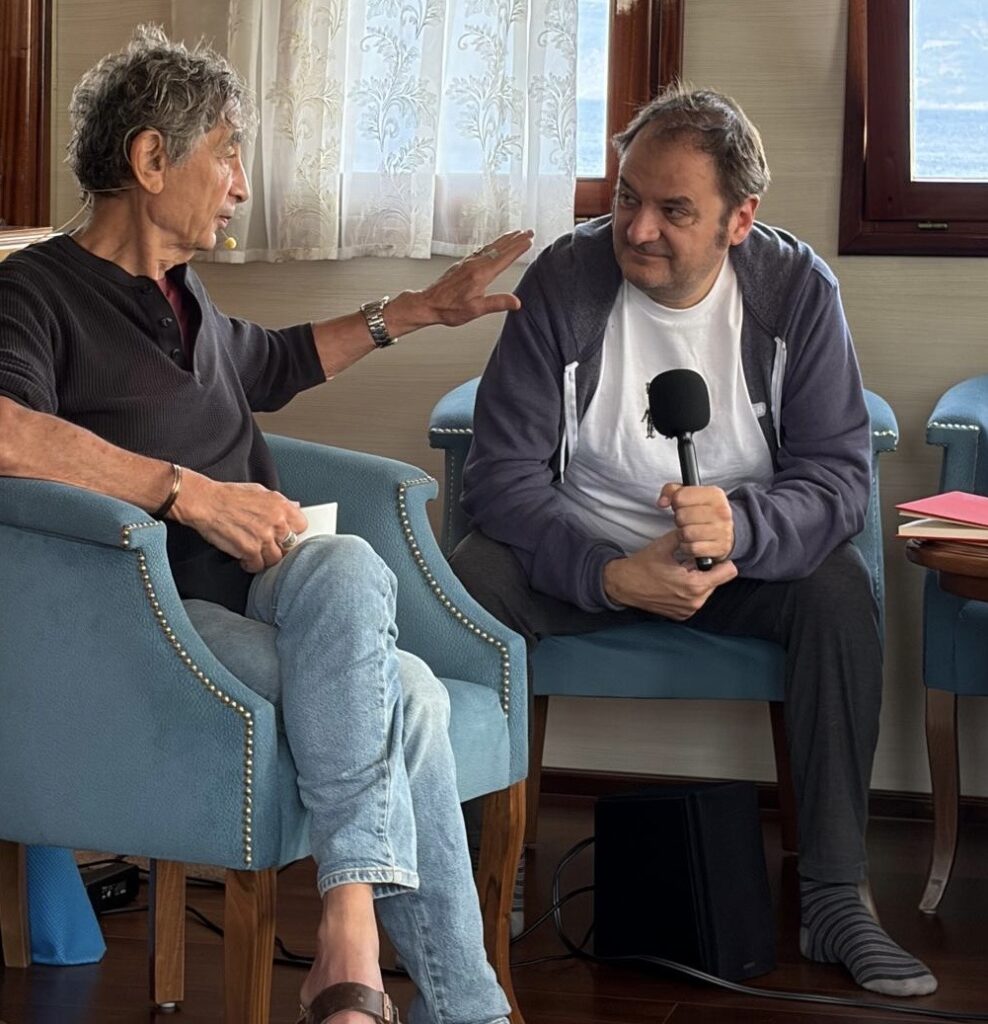
Esta noche regresamos a Barcelona después de ocho días en un barco participando en las sesiones de Gabor Maté. Yo me sentaba cada día a su lado, como se ve en la foto, y así podía utilizarme de «conejito de Indias», como él decía.
También tuve un encuentro personal con él de casi media hora, que es lo que me he comprometido a contar aquí.
Debo decir que una entrevista one-to-one con Gabor es lo más incómodo que puedes experimentar. Mientras te atraviesa con esa mirada triste, le basta con una frase o con una pregunta para dejarte desnudo.
Es una experiencia que ya viví al entrevistarle, hace un par de años, con motivo de la publicación de su libro El mito de la normalidad. He estado recuperando esa conversación para un próximo audiolibro:
—Gabor, en un capítulo de tu libro hablas de la culpa, un tema que me parece muy interesante. ¿Qué le dirías a alguien que no se siente orgulloso de algún episodio de su pasado? Teniendo en cuenta que no se puedes cambiar…
—Supongo que hablas de ti, ¿verdad? —me interrumpió él.
—Sí… —contesté avergonzado.
—Cuando tú actuaste de aquella manera de la que hoy no te sientes orgulloso, ¿sabías que estaba mal o que podía causar algún daño?
—No, realmente no era consciente.
—Entonces estabas ciego —sentenció Gabor—. Y, ¿se puede culpar al ciego de no poder ver?
En esta ocasión, cara a cara en un saloncito del barco, le hablé de las dificultades que había tenido para relacionarme con mi padre, muerto hace más de quince años, y cómo eso había hecho de mí una persona melancólica, aunque siempre esté rodeado de gente.
—Vamos a hablar de verdad —me para Gabor—. Todo lo que me estás contando ahora ya lo has explicado a otra gente, ¿verdad? A un amigo, en un libro, a algún terapeuta…
—Sí… Es un tema recurrente en mi vida.
—Vale, pues necesito que me expliques algo de tu padre que no hayas contado nunca a nadie.
—¿Nunca?
—Eso mismo. Algo que te has guardado para ti pero que jamás te has atrevido a verbalizar. Estás en un espacio seguro, esto quedará entre nosotros.
Ahí estás jodido, porque si hay algo que nunca has contado es porque no lo quieres contar. Es algo que preferirías que no sepa nadie. Y Gabor no te deja otro remedio que soltar esa última capa, arrancarte la piel.
Al final de la sesión, me reconoce que somos parecidos: no sabe estar sin hacer nada porque, si se para, regresa la tristeza.
—Soy un pésimo meditador como tú —termina—. Lo máximo que he conseguido meditar son 6 minutos.
Bueno, ahora voy a contestar yo, por escrito y a mi manera, a la consulta de la semana.
PREGÚNTALE A FRANCESC
—Llevo mucho tiempo dejándome llevar por la corriente sin saber qué quiero hacer con mi vida. Tengo 32 años, no me gusta nada mi trabajo, pero no sé por dónde empezar o qué dirección tomar. Siento que estoy perdiendo mi vida y eso me da miedo. (Maria C.)
Querida Maria, empezaré por decirte que 32 años es una edad perfecta para un cambio vital. Estás al fin del primer tercio de su vida. Hace un siglo, cuando la esperanza de vida era bastante menor que ahora, a los 33 Henry Miller dejaba su trabajo directivo en Western Union y su sueldo. Abandonó Nueva York, con una mano delante y otra detrás, y se trasladó a París para llevar una vida absolutamente bohemia, sin dinero y viviendo de prestado, para cumplir el sueño de ser escritor. A veces comía lo que encontraba en cubos de basura.
No digo que te tires a una piscina sin agua, como Miller, porque tampoco sé qué responsabilidades económicas tienes. Siempre que alguien me pregunta por un cambio de vida, empiezo por preguntarle cuánto cuesta la suya mensualmente y qué colchón económico tiene. Es decir, cuánto podría aguantar si dejara el trabajo para emprender algo nuevo.
A no ser que seas un gorrón como Henry Miller, que vivía de las mujeres y pedía préstamos que no devolvía, para un cambio de vida hace falta un plan para esa transición, que a veces se completa en varios años. En el punto en el que tú estás, te propongo que antes te hagas estas preguntas:
- ¿Cuál es tu talento natural? Si no lo sabes, pregunta a quienes te conocen.
- ¿Te gustaría poner ese talento al servicio de los demás? ¿Cómo imaginas que podrías hacerlo? ¿A través de que trabajo o proyecto?
- ¿Qué te hace falta para convertir esa idea en algo realizable? ¿Necesitas formarte? ¿Ahorrar? ¿Cuánto tiempo te llevaría vivir de eso?
- Es muy posible que tengas que hacer una transición, es decir, que por un tiempo tengas que combinar ese trabajo que no te gusta con la preparación de tu próxima vida, hasta que sea el momento propicio de dar el paso.
Como puedes ver, esto es una carrera de fondo.
¡Te deseo todo lo mejor!
F
Empezamos ya las presentaciones del libro sobre OJALÁ LO HUBIERA SABIDO ANTES. ¡Nos vemos el martes en Barcelona! Si no te has inscrito aún, puedes hacerlo aquí: https://escueladetransformacionvital.com/libro-ojala/
¡Abrazos y feliz semana!
Francesc
—
Últimas entradas para el IKIGAI SHOW de noviembre
Puedes comprar la tuya aquí: https://shorturl.at/IRE8l

—
Speaking with Gabor
Good morning,
Tonight we return to Barcelona after eight days on a boat, participating in sessions led by Gabor Maté. I sat next to him every day —as you can see in the photo —which allowed him to use me as a “guinea pig”, as he put it.
I also had a private, one-on-one meeting with him lasting nearly half an hour, and that is what I’ve committed to sharing here.
I must say, a personal conversation with Gabor is one of the most uncomfortable experiences imaginable. As he pierces you with that sad gaze, a single sentence or question from him is enough to leave you completely exposed.
It is an experience I had previously undergone when interviewing him a couple of years ago, upon the publication of his book The Myth of Normal. I have been revisiting that conversation for an upcoming audiobook:
—Gabor, in one chapter of your book, you discuss guilt; it’s a topic I find very interesting. What would you say to someone who isn’t proud of a particular episode from their past? Bearing in mind that it cannot be changed…
—I assume you’re talking about yourself, right? —he interrupted.
—Yes… —I replied, feeling embarrassed.
—When you acted in that way —the way you aren’t proud of today—, did you know it was wrong or that it could cause harm?
—No, I wasn’t really aware of it.
—Then you were blind —Gabor stated firmly—. And can a blind person be blamed for not being able to see?
This time, face-to-face in a small lounge on the ship, I spoke to him about the difficulties I’d had relating to my father —who died more than fifteen years ago—and how that turned me into a melancholic person, even though I’m always surrounded by people.
—Let’s get real — Gabor interrupts—, Everything you’re telling me now, you’ve already explained it to other people, right? To a friend, in a book, to a therapist…
—Yes… It’s a recurring theme in my life.
—Okay, then I need you to tell me something about your father that you’ve never told anyone else.
—Never?
—Exactly. Something you’ve kept to yourself but never dared to put into words. You’re in a safe space; this stays between us.
That’s where you’re screwed, because if there’s something you’ve never told, it’s because you don’t want to tell it. It’s something you’d prefer no one knew. And Gabor leaves you no choice but to shed that final layer, to tear off your own skin.
At the end of the session, he admits that we’re alike: he doesn’t know how to just sit and do nothing because, if he stops, the sadness comes back.
—I’m a terrible meditator, just like you —he concludes—. The longest I’ve ever managed to meditate is six minutes.
Well, now I’m going to answer the week’s question myself, in writing and in my own way.
ASK FRANCESC
—I’ve spent a long time just drifting along without knowing what I want to do with my life. I’m 32, I really hate my job, but I don’t know where to start or which direction to take. I feel like I’m wasting my life, and that scares me. (Maria C.)
Dear Maria, let me start by saying that 32 is the perfect age for a life change. You are at the end of the first third of your life. A century ago, when life expectancy was much lower than it is today, with 33 Henry Miller walked away from his executive job at Western Union and the salary that came with it. He left New York with virtually nothing to his name and moved to Paris to live a truly bohemian life, penniless and relying on the charity of others, in order to pursue his dream of becoming a writer. At times, he even ate food he found in trash cans.
I’m not suggesting you dive into an empty pool like Miller did, not least because I don’t know what financial responsibilities you have. Whenever someone asks me about changing their life, I start by asking how much their current lifestyle costs each month and what kind of financial cushion they have; in other words, how long they could hold out if they quit their job to start something new.
Unless you’re a freeloader like Henry Miller, who lived off women and took out loans he never repaid, making a life change requires a plan for the transition, a process that can sometimes take several years. Given where you are right now, I suggest you first ask yourself these questions:
- What is your natural talent? If you don’t know, ask the people who know you better.
- Would you like to put that talent to use for the benefit of others? How do you envision doing that? Through what kind of job or project?
- What do you need to turn that idea into something achievable? Do you need training? To save money? How long would it take for you to make a living from it?
- You may well need to go through a transition, meaning that, for a time, you might have to combine the job you dislike with preparing for your next chapter, until the moment is right to take the leap.
As you can see, this is a long-distance run.
I wish you all the best!
F
We are kicking off the book presentations for OJALÁ LO HUBIERA SABIDO ANTES (If Only I Had Known Sooner). See you on Tuesday in Barcelona! If you haven’t signed up yet, you can do so here:
https://escueladetransformacionvital.com/libro-ojala/
Warm regards and have a great week!
Francesc